

The ink is finally dry on Comcast’s separation of its cable assets into Versant Media Group (VSNT). No position in either CMCSA or VSNT— except I think my mother owns some Comcast shares in a brokerage account somewhere, I should probably check on that. I do think its a good idea for Comcast, it’s a strategic purging of the ballast. A topic for another post someday: Comcast has lost more ground to satellite internet and wireless than I would have thought 10 years ago. The initial thoughts were that 5G and satellite couldn’t pump out the bandwidth that broadband/fiber could, and peoples’ data consumption would just asymptotically go up, causing bad unit economics for wireless. I don’t know if that’s happened. It’s interesting to say the least.
For the event guys like myself looking for cigar butts, this is a case study in what not to look for, in my view. Trying to get a puff out of this one will be nigh-impossible, save for a total take-private. That outcome is unlikely and most likely Versant ends up in the hands of a creditor committee.
Brief History Lesson
It’s crazy to remember how great these network businesses once were. The bundle was the original SaaS with upsold modules/features. Wanted the Food Network? Sorry, the only way you get that is if you also pay for CNBC. Also, the network gets to decide the advertising mix, and can match those ads to the demographics of the channels. The double barrel approach just kept scaling off broadband passings, which continue to grow to this day. Cable Cowboy, the story of John Malone, has great insights into how these buildouts were funded, and how some of the cable networks like BET and CNN started as JVs between cable companies.
Unfortunately for VSNT, media investors want one thing: growth. Specifically, the kind of growth found in streaming, digital ads, or anything where you can take a fixed content cost and scale it across a 7 billion user platform like the internet. Virtually zero incremental cost of delivering the content means that every incremental dollar of ad revenue or carriage revenue or whatever is incremental cash flow. Pretty great business model! Malone understood this, as did Netflix, as did Facebook, as did Spotify.
The word “disruption” gets thrown around a lot, but this is a great example of it actually occurring. The cable network was totally disintermediated by a different distribution channel (internet vs. TV) and was forced to compete with global and dynamic content. Every single Youtube channel, every single Twitch streamer, every social media post competes directly with cable networks now. And their value prop to advertisers is even better than the networks’: the internet has cookies and IP addresses and pixel trackers. Maybe that was the crux of the value destruction: the ability to target demographics that cable had was of greater value than actual combined reach of the networks.
The Looting Phase
When an organization knows its best days are in the rearview mirror, the culture shifts from innovation to extraction. We’ve seen it in retail, real estate, banking, government, newspapers, and we’ll see it here. Shadow liabilities like severance, future stock option re-strikes for executives, exiting leases early, and future weird acquisitions to attempt to save the declining business don’t show up on the GAAP balance sheet, but they’re future cash outflows, nonetheless.
In a declining business, you eventually see what I would term the “laissez-faire exit strategy.” Talent looks toward the doors (anchors and others start their own YouTube channels or streams) and management focuses on maximizing short-term numbers to hit sell-side estimates to pump their stock. When the “house of brands” is actually a collection of melting ice cubes, the primary goal of the occupants is usually just to keep getting their paychecks until the bitter end, all the while promising a turnaround right around the corner.
Financial Leverage + Operating Leverage = Things Happen Faster
The most telling part of this deal is the balance sheet. Versant got saddled with $3B of debt ($2.25B, net of $750M of cash) after what amounted to a PE-style dividend recap by Comcast. I have yet to see a meaningful turnaround or an elegant liquidation in an analogous situation, particularly with something involving as many big personalities. The sequence goes something like this:
1.) Employees of the business think the turnaround is right around the corner. They’re just a few days away from being relevant. Or maybe one transformative acquisition away. They’ll try to show greenshoots (maybe some aberrant viewership growth at some network something). This despite all the evidence to the contrary. The CEO’s name is Lazarus, a perfect aptonym!
2.) The value investor base at this multiple really only cares about one thing: returning as much cash as possible back before the ice cube melts, not reinvesting in the business. The growth investor base will ever look at this thing again absent the government shutting down the internet, or something.
3.) Therefore a natural conflict will brew between the shareholder base and the employee base, the other one seeing the other as impediments to their goals.
4.) The employees will win and investors will move on. This is why the only saving grace is a takeout, which is unlikely because of the debt load (just buy it out of Chap. 11).
I think it’s safe to say you could maybe pull $3-4B of cash out of the business. But it’s dicey. Making generous assumptions, you’re still looking out at $4-5B company. I would say these assumptions would constitute a bull case, to be honest:
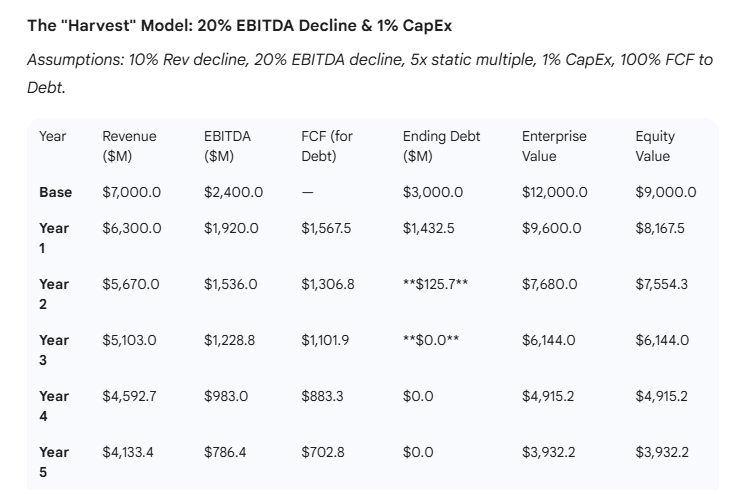
Ben Graham once said that a no-growth business should trade at a 8.5x earnings. Interestingly, his little formula doesn’t work for negative growth businesses. Whatever, no one’s does, but it just goes to show that even a guy like Graham was incredibly wary of negative-trajectory businesses.
Comcast has successfully offloaded its “cable albatross.” Versant is now free to navigate the storm on its own—it just happens to be doing so in a leaky boat with a very heavy anchor. It could be worth a swing simply because of volatility, but it’s so hard to get excited about it.